We can vote until the cows come home but the Electoral College makes sure the candidate with the most votes loses.
It's the Electoral College.
#Stupid
It's the Electoral College.
#Stupid


The message is clear: Making America Great Again means purging everyone who isn’t white and Christian.There can be no more pretenses. The mean spirit is manifested in Voter ID laws, Republican Gerrymandering, and Citizens United.

BREAKING: Tea Partier Wins KY Gov Race After Promising To Take Healthcare From 400,000 in KY https://t.co/6V1rkVjVP8 pic.twitter.com/D3JpXjURR0
— The Baxter Bean (@TheBaxterBean) November 4, 2015

Hey, @chucktodd, you missed the story. Again.
I fixed your monitor headline. You're welcome.
#MTP pic.twitter.com/Rl7Z5BZDv6
— Steve Marmel (@Marmel) November 16, 2014
The Game is rigged. Between Voter Suppression, gerrymandering, and
Citizens United ,Democrats will never "win" an election in the United
States of the America.
WASHINGTON — The Tea Party Republicans should hang a “Mission Accomplished” banner across the House of Representatives. They could flank it with large portraits of Senator Ted Cruz, the Texas Republican who has in fact, if not in name, replaced John Boehner as Speaker of the House. The right-wing extremists got exactly what they wanted. Now, what will the country do about it?
On the day the Affordable Care Act takes effect, the U.S. government is shut down, and it may be permanently broken. You’ll read lots of explanations for the dysfunction, but the simple truth is this: It’s the culmination of 50 years of evolving yet consistent Republican strategy to depict government as the enemy, an oppressor that works primarily as the protector of and provider for African-Americans, to the detriment of everyone else. The fact that everything came apart under our first African-American president wasn’t an accident, it was probably inevitable.
"In a democracy, hostage tactics are the last resort for those who can’t otherwise win their fights through elections, can’t win their fights in Congress, can’t win their fights for the Presidency, and can’t win their fights in Courts," Warren said. "For this right-wing minority, hostage-taking is all they have left – a last gasp of those who cannot cope with the realities of our democracy."The GOP Takes It's Clothes Off in Public: It's Not a Pretty Sight, Even For Some Republicans
And so, the "moderate" (ho, ho, ho) House Republicans tell us that what they are afraid of is primary challenges from the "Tea Party" should they vote for rationality on the continuing resolution matter and then on the perhaps more important debt ceiling increase that is just around the corner. Well yes, many of them would face such challenges, but the overall national leadership of the GOP is just as afraid of them as any individual House member is. For in the highly gerrymandered districts inhabited by so many Republicans in the House, many of those challenges would be effective. But then, in the general election, given decent Democratic candidates with some money from the DNC, even in gerrymandered districts, as happened in a few elections in 2010 and 2012, the far-rightists might be so far-right, that Democrats might be able to take over the House. To say nothing of what it might do to GOP chances in the state–wide elections for Governor and Senator. Then there's Ted Cruz and 2016. A big OY! on that one.That Thing about Congress Being "Exempted from ObamaCare? A Huge Whopper
You might’ve heard just about every Republican member of Congress, along with Fox News and AM talk radio, shrieking about how President Obama has “exempted” Congress from Obamacare. The point they’re trying to make is that Obamacare is so awful and so ridiculous that the Obama administration has offered Congress a Get-Out-Of-Obamacare-Free card. Taking it one step further, they’re insisting that if Obamacare isn’t good enough for Congress, why should the American people be forced to endure its awfulness? The people should be exempted, too, which means the elimination of the individual mandate, and, without the mandate (a Republican idea by the way), premiums would skyrocket and the law would explode. Political sabotage, pure and simple.Bad politicians were sent to Washington by Citizens United, Gerrymandering, and Voter Suppression.
But let’s not forget who draws the lines for redistricting—state lawmakers (and in a few states, commissions appointed by the states). These legislators are often chosen in midterm and off-year elections in which the composition of the electorate has tended to be older and whiter than in presidential election years. That helps explain why the Democrats took a beating in 2010. The lesson is that midterm elections can have big consequences. If Democrats ever want to win back the House, they have to get their people to the polls in the off years. And if the Supreme Court guts the Voting Rights Act, it will be more important than ever.

The immediate result is that Arizona can continue to harass and detain Latinos even if it can't deport them unilaterally. Naturally, there are limits imposed by the plain language of the bill, but proving that the effect of this section is to create unlawful racial harassment remains to be proven in court.
While that is being litigated, other red states can pass their own Latino harassment laws, and some may do so. This is bad news for Mitt Romney, who upheld the Arizona law as a model for the country.
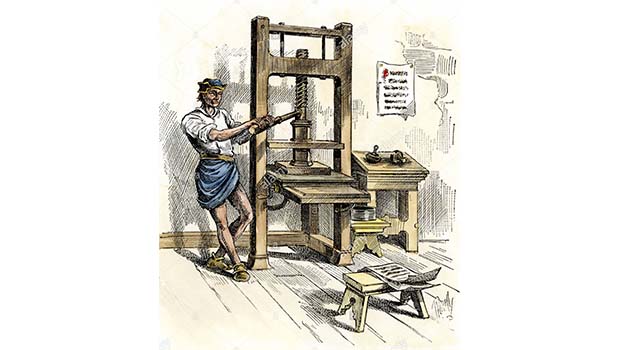 |
| America’s first printing press was built by two English-born colonists who came to the colonies with a specific agenda in mind on 25 September 1639. |
For the record, I agree with XXX that XXXXX XXX has the right to ban me or anyone else they so choose. Those of us on the outside have the right to ask: "What is this Web site really all about? Is it about progressive ideas or something else?'And this:
Again, XXX has every right to do that, but I question what kind of agenda they really have. Questioning authority, and reporting on misconduct, are fundamentals of liberalism and an aggressive press--as I see it. If XXX does not support such activities, I don't think liberals should look to that site to spearhead any meaningful change that will benefit regular folks.This Blogger believes Blog owners have the right to ban people, just like ESPN had the right to fire Hank Williams, Jr. after his comparison of President Obama to Hitler on Fox and Friends. I vehemently disagree with both premises. I believe to ban people because they express a point of view owners and editors don't agree with is a violation of the First Amendment. If you can lose your job, or be banned from publishing because of something you write, do you have freedom of speech? I submit the answer is NO.
Freedom of the press belongs to the owner of the press. Don't ask me, ask the SCOTUS. I put it on my business card because a keyboard and a camera are my press.Oh really? Think about that first sentence. Freedom of the press belongs to the owner of the press. Are owners of the press free to suppress the opinions of those who aren't owners? Are owners of the press the only ones with freedom of speech? I HOPE not.
Citizens United v. Federal Election Commission, 558 U.S. _ (2010), was a landmark decision by the United States Supreme Court holding that the First Amendment protects corporate and union funding of independent political broadcasts in candidate elections. The 5–4 decision originated in a dispute over whether the non-profit corporation Citizens United could air a film critical of Hillary Clinton, and whether the group could advertise the film in broadcast ads featuring Clinton's image, in apparent violation of the 2002 Bipartisan Campaign Reform Act, commonly known as the McCain–Feingold Act, in reference to its primary Senate sponsors.[2]I guess it's hard for people who haven't had to fight for basic civil and human rights to understand what is at stake here, but this freedom of the press belongs to the owner of the press meme is beginning to sound like the private businesses don't have to serve blacks meme.
Freedom of the press or freedom of the media is the freedom of communication and expression through vehicles including various electronic media and published materials. While such freedom mostly implies the absence of interference from an overreaching state, its preservation may be sought through constitutional or other legal protections.I want my free press back.
Fear of serious injury cannot alone justify suppression of free speech and assembly. Men feared witches and burned women. It is the function of speech to free men from the bondage of irrational fears.~Justice Louis D. Brandeis
Citizens United v. Federal Election Commission, 558 U.S. 08-205 (2010), was a landmark decision by the United States Supreme Court holding that corporate funding of independent political broadcasts in candidate elections cannot be limited—because of the First Amendment. The 5–4 decision, in favor of Citizens United, resulted from a dispute over whether the non-profit corporation Citizens United could air a film critical of Hillary Clinton, and whether the group could advertise the film in broadcast ads featuring Clinton's image, in apparent violation of the 2002 Bipartisan Campaign Reform Act, commonly known as the McCain–Feingold Act.[2]So, if corporations can make unlimited campaign contributions in the name of free speech, why can't people tell candidates they will vote for them if they share their interest? Certainly you don't believe corporations are donating million to candidates who don't share their interest?
The decision reached the Supreme Court on appeal from a January 2008 decision by the United States District Court for the District of Columbia. The lower court decision upheld provisions of the McCain–Feingold Act which prevented the film Hillary: The Movie from being shown on television within 30 days of 2008 Democratic primaries.[1][3]
The Court struck down a provision of the McCain–Feingold Act that prohibited all corporations, both for-profit and not-for-profit, and unions from broadcasting “electioneering communications.”[2] An "electioneering communication" was defined in McCain–Feingold as a broadcast, cable, or satellite communication that mentioned a candidate within 60 days of a general election or thirty days of a primary. The decision overruled Austin v. Michigan Chamber of Commerce (1990) and partially overruled McConnell v. Federal Election Commission (2003).[4] McCain–Feingold had previously been weakened, without overruling McConnell, in Federal Election Commission v. Wisconsin Right to Life, Inc. (2007). The Court did uphold requirements for disclaimer and disclosure by sponsors of advertisements. The case did not involve the federal ban on direct contributions from corporations or unions to candidate campaigns or political parties.[5]
Let me relate to you an actual situation that happened last year. A member of Congress made a fundraising call to someone I know, obviously hoping for a contribution. The potential donor was very upfront that the health care reform bill was their top priority and said, "If you support this bill, call me again and I'll definitely support your campaign." Now, it's a federal campaign, so the amount is obviously limited to $2400 (or $4800 for primary & general) but it's pretty clearly a specific vote at issue.By your standard, politicians are guilty of bribing voters when they say I will vote to repeal ObamaCare if you vote for me, and voters are guilty of bribing candidates/elected officials when they say I will vote for you if you vote to repeal ObamaCare.
I know the potential donor and the intent was not to bribe but to put pressure on a representative before an important vote and draw a bright line on a particular issue -- don't call me for money unless you vote for HCR.
The question this case raises (as did the Siegelman case) is - when does a campaign contribution become a bribe?
However before we get to that, remember that Beason testifed (sic) he was offered a $1,000,000.00 per year "consulting" contract in return for his vote which, if true, would clearly be a bribe.
To the main question - most State (and the Federal) bribery statutes define bribery as offering a pecuniary benefit or a "thing of value" to a public official(sic) with the intent that the official's (sic) vote or action will be "corruptly" influemced (sic).
The line between campaign contribution and a bribe is a fine one. Generally to be a bribe, the government must prove a "quid pro quo" -that is the contribution must be given in exchange for a specific vote. Federal Courts have held that money "given freely without the promise of a specific action in return is not a bribe even if they are intended to "build a reservoir of goodwill that might ultimately affect one or more of a multitude of unspecified acts, now or in the future".


